


언어 변경
ko
언어 변경
ko
logo 뉴스 What Is a Jib on a Crane Used For?

What Is a Jib on a Crane Used For?

06-24-2025
✅ Copied Link!
Jib Crane

Whether lifting components on an assembly line or transporting loads on a dock, jib cranes enable efficient, safe, and space-conscious lifting. This guide explores the key uses of jib cranes, the industries they serve, and how different types—including freestanding, wall-mounted, and articulating jib cranes—deliver unique operational benefits.

Understanding the Jib: The Core of a Jib Crane

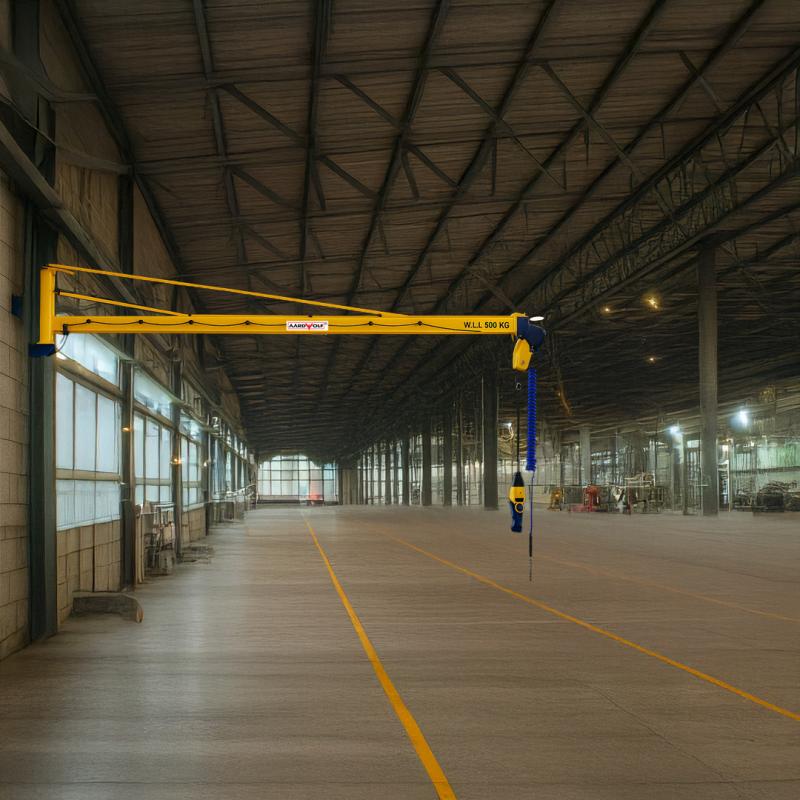
The “jib” refers to the horizontal arm of the crane that extends from the main vertical mast or support structure. It is the critical part that carries the lifting device (usually a hoist) and allows for rotational movement—typically up to 360 degrees in freestanding models. With this arc-like motion, jib cranes are ideal for repetitive or localized lifting tasks where precision and reach are required.

Jib cranes provide a straightforward lifting solution for industries that need reliable, flexible, and safe equipment for moving goods.

Common Uses of Jib Cranes in Industrial Environments
Jib cranes play a crucial role in tasks requiring precision, such as placing steel beams or heavy machinery. Their ability to rotate and cover a wide area ensures that construction projects can proceed with efficiency and accuracy. In manufacturing, Jib cranes prove indispensable for seamless material handling.

1. Manufacturing Workstations

Jib cranes are widely used in manufacturing where parts need to be lifted and placed accurately. They are commonly mounted on the floor near production cells or integrated into existing columns.

Task Examples: Lifting engine blocks, rotating machinery parts, transferring parts between conveyors.

Exploring different types of jib cranes helps manufacturers find the right model for their specific needs.

2. Shipping and Loading Areas

On docks or loading bays, jib cranes assist with material transfer between ships, trucks, and warehouses. They support both light-duty and heavy-duty tasks.

Benefits: Reduced manual lifting, improved loading speed, increased operator safety.

3. Warehousing and Inventory Management

In storage facilities, jib cranes handle the precise movement of palletized goods or fragile items. Their rotation and span can be customized to fit tight aisles or corners.

Use Case: Positioning goods on racking systems or feeding materials into packaging lines.

4. Assembly and Fabrication Facilities

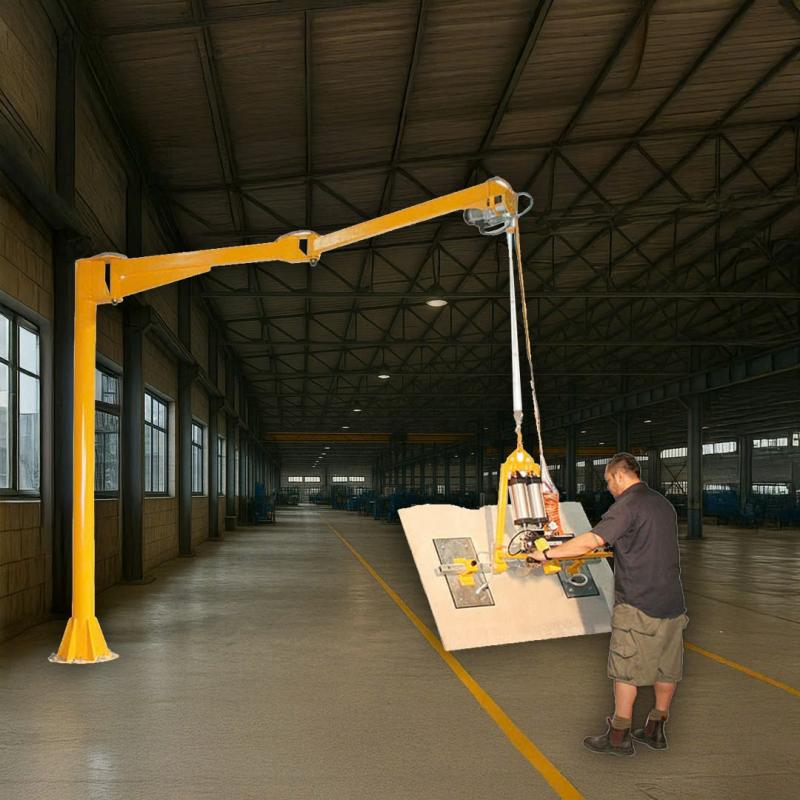
Articulating and wall-mounted jib cranes are ideal in assembly and welding stations where high precision and small space operation are critical

Example: A welder can swing parts into position without disrupting nearby equipment.

Smart jib cranes feature intelligent safety, which makes them ideal for integration into digital factory environments.

Popular Types of Jib Cranes and Their Use Cases

Jib cranes are overhead lifting devices commonly used in workshops, factories, and construction sites. Popular types include freestanding, wall-mounted, mast-type, and articulating jib cranes, each with specific use cases. Freestanding cranes offer 360° rotation and are ideal for versatile material handling. Wall-mounted cranes save space and are suitable for fixed workstations. Mast-type cranes are used for lifting materials to great heights, while articulating cranes offer flexibility for maneuvering around obstacles. 

Freestanding Jib Crane
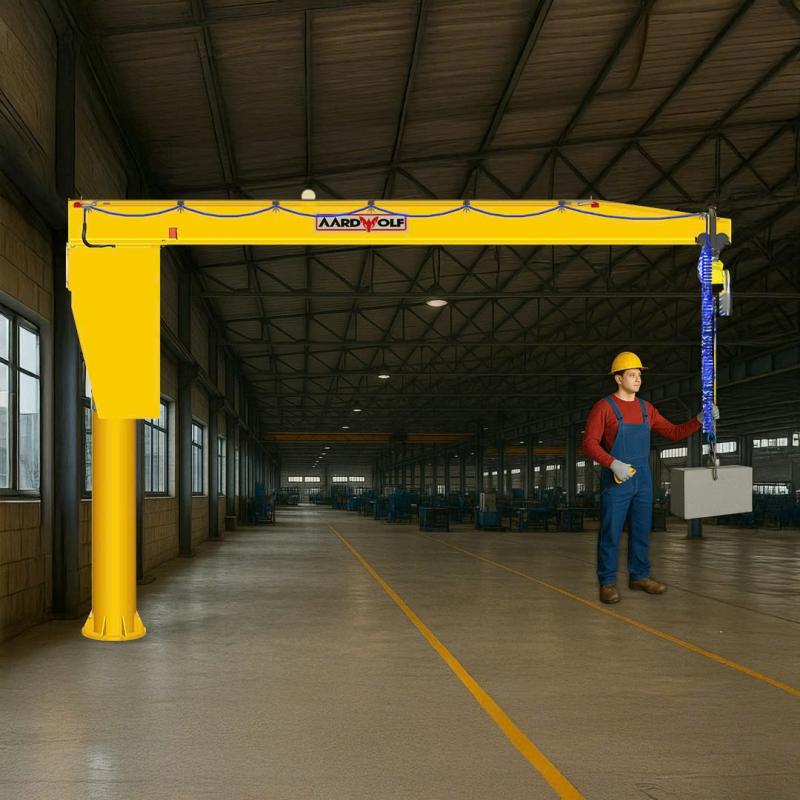
A freestanding jib crane is a type of crane that is self-supporting and anchored to the floor, typically using bolts, without requiring additional support from the building structure. It consists of a horizontal boom (or jib) that rotates on a vertical mast, allowing it to move loads in a circular area. These cranes are versatile, commonly used in manufacturing, warehouses, and loading docks for lifting and moving materials. 

Best For: Versatile, high-capacity lifting indoors or outdoors.
Applications: Assembly lines, shipyards, outdoor yards.
Features: 360° rotation, heavy-duty design, mounted to foundation or base plate.

Wall Mounted Jib Crane
A wall-mounted jib crane is a type of jib crane that is attached to a wall or a structural column, rather than being a freestanding unit. This mounting style allows it to save valuable floor space, making it suitable for areas where floor space is limited or where obstructions exist. These cranes are often used in workshops, warehouses, and other industrial settings where repetitive lifting tasks are required. 

Best For: Space-saving solutions in small workshops or warehouses.
Applications: Fabrication shops, repair bays, maintenance areas.
Features: Mounted on walls/columns, foldable arms, no floor space required.

Articulating Jib Crane
An articulating jib crane is a type of jib crane featuring two arms connected by a flexible joint, allowing for a wider range of movement than traditional jib cranes. This design enables the crane to maneuver loads around corners, reach into and under machinery, and access areas that are difficult to reach with standard jib cranes. 

Best For: Complex or confined areas with obstacles.
Applications: CNC loading, machine maintenance, cleanrooms.
Features: Dual-arm articulation, precision load positioning, smooth maneuverability.

Ceiling Mounted Jib Crane
A ceiling-mounted jib crane is a type of crane that is suspended from the ceiling or building structure, rather than being mounted on a floor-standing support. This design maximizes floor space utilization and allows for lifting and moving loads in areas with obstructions or limited headroom. They are particularly useful in facilities where floor space is at a premium or where loads need to be moved around corners, into machines, or under obstructions. 

Best For: Facilities with limited floor space but open overhead structure.
Applications: Warehouses, distribution centers.
Features: 360° motion, mounted to ceiling beams, excellent headroom.

Pillar (Mast Type) Jib Crane
A pillar or mast-type jib crane is a type of crane that uses a vertical pillar or mast to support a horizontal jib arm (also called a boom). This design allows the crane to rotate a full 360 degrees, providing comprehensive coverage for material handling in a specific area. Pillar jib cranes are commonly used in industrial settings, such as workshops, warehouses, and assembly lines, where localized lifting and material transport are needed. 

Best For: Fixed lifting with minimal floor interference.
Applications: Industrial assembly, shipping bays.
Features: Tied to floor and ceiling beams, stable and cost-effective.

The diverse range of jib crane types offers tailored options for specialized operations.

What Loads Can a Jib Crane Handle?

Jib cranes can handle a wide range of loads, typically from 100 kg to 10 tons, depending on the specific type and configuration. Light-duty jib cranes are often rated for loads between 0.5 to 2 tons, while heavy-duty models can handle up to 10 tons or more. Load handling is determined by factors such as:

Boom length and type
Hoist system (manual, electric, or pneumatic)
Mounting method (freestanding, wall, ceiling)
Duty cycle classification (from light-duty Class A1 to heavy-duty Class F)

Typical Lifting Tasks:

Engine blocks
Tooling equipment
Sheet metal
Raw materials
Pallets


Advantages of Using Jib Cranes
Jib cranes offer several advantages, including improved safety, increased productivity, and cost-effectiveness, especially in localized lifting and material handling tasks. Their ability to operate in confined spaces, provide precise control, and adapt to various applications make them valuable in a wide range of industries. 

Increased Safety: Reduces injury risks from manual lifting.
Space Optimization: Wall and ceiling models save valuable floor space.
Efficiency Boost: Streamlined material flow supports lean operations.
Flexibility: Easily repositioned (portable versions) or integrated with other systems.
Precision: Fine control in hoisting makes it ideal for sensitive components.

The potential of these advanced lifting solutions lies in their customizable operation for specific production needs.


Smart Features and Modern Enhancements

Today's smart jib cranes are equipped with advanced features like enhanced safety mechanisms, real-time load monitoring, automation, and integration with broader facility operations. These features include overload protection, automated limit switches, emergency stops, and the ability to log lifting data for audits. They also utilize sensors for load detection and collision avoidance, and integrate with warehouse management systems (WMS). 

Variable speed hoists

Wireless remote controls

Integrated sensors for load monitoring


Safety features like rotation stops and overload protection

The smart jib cranes utilize automation to deliver improved performance and digital tracking.


Conclusion: What Is a Jib on a Crane Used For?
A jib on a crane is a horizontal or near-horizontal beam that extends from the crane's main structure, typically the boom. Its primary function is to provide extended reach and articulation for lifting and moving loads, especially over obstacles or at a distance from the crane's center. 

From assembly lines to warehouse aisles, jib cranes provide smart, efficient, and safe lifting solutions. They are available in multiple configurations—freestanding, wall-mounted, ceiling-mounted, articulating, and portable—making them suitable for virtually every industrial environment.

Choosing and Installing the Right Jib Crane ensures productivity, safety, and long-term value.

References

1.     How to operate a Jib Crane safely

2.     What is a Jib Crane?

3.     Over brace jib crane wall mounted

4.     Wall mounted Jib Crane

5.     Is a Jib Crane a Gantry Crane

6.     Articulated Jib Crane Wall Mounted

7.     Where is Jib Crane used?

8.     Manual Counterbalance Crane

9.     Floor Mounted Jib Crane

10.  Over Braced Jib Crane Column Mounted

11.  Powered counterbalance Crane


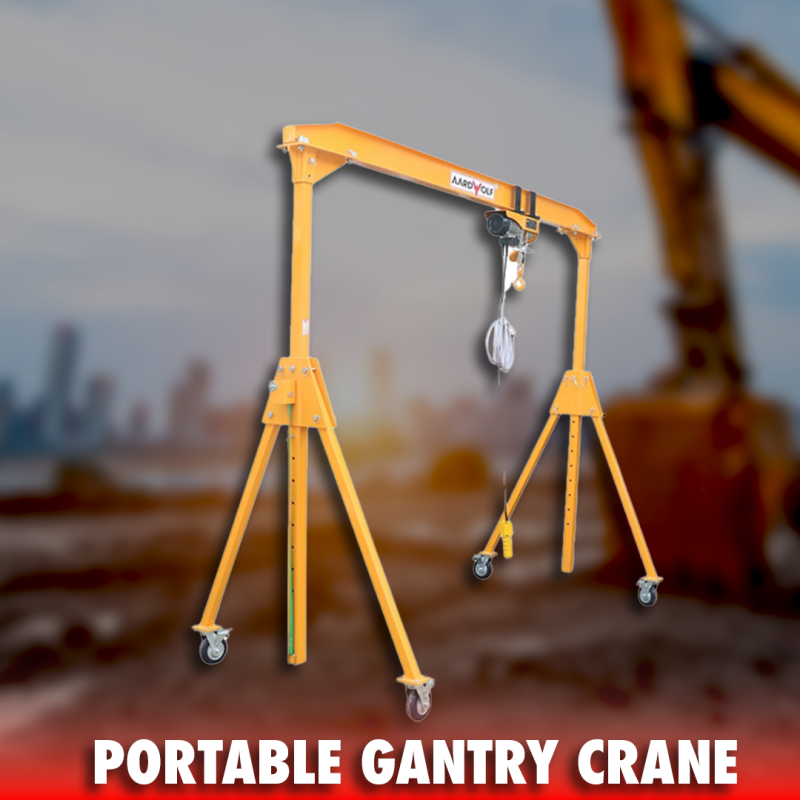
12.   Portable Gantry Crane


이메일 가입

Aardwolf의 신제품, 특별 할인 및 기타 정보를 받으려면 가입하세요.

가입하면 Aardwolf로부터 뉴스, 특별 할인, 프로모션 및 기타 정보를 이메일로 받는 데 동의하게 됩니다. 언제든지 구독을 취소할 수 있습니다.