











 뉴스
Wall-Mounted Jib Cranes: Space-Saving Lifting Solutions
뉴스
Wall-Mounted Jib Cranes: Space-Saving Lifting Solutions
언어 변경



우리를 팔로우하세요


 Share
Share
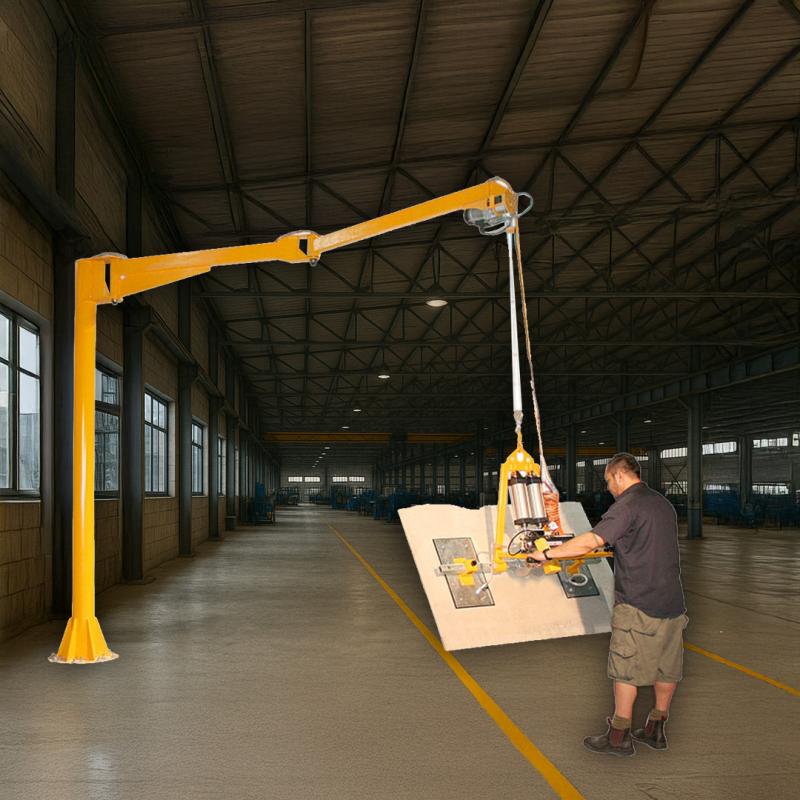
That’s where wall-mounted jib cranes stand out. These cranes are purpose-built to deliver localized lifting support while minimizing the equipment footprint, making them ideal for small workshops, loading docks, assembly lines, and more.
As part of the broader jib cranes category, wall-mounted options combine efficiency with economy—offering robust lifting capacity without interfering with valuable ground space. This article explores how wall-mounted jib cranes work, their advantages over other models, and when to use them.
For a full range of Jib Cranes, including wall-mounted, freestanding, ceiling-mounted, and articulating models, visit Aardwolf's product line.
A wall-mounted jib crane is a type of jib crane attached directly to a structural wall or column within a building. Unlike freestanding jib cranes, which require a reinforced concrete foundation, wall-mounted cranes rely on existing structural support. The arm, or “jib,” typically offers up to 180 degrees of rotation, allowing materials to be moved in a semi-circular arc.
This crane model is popular in facilities where:
Floor space is limited or congested
Supplemental lifting is needed alongside other machinery
The structure is strong enough to support lateral loads
If you're unfamiliar with the structural distinctions among crane types, here's a great breakdown:
What is the difference between a crane and a jib crane
The biggest advantage of wall-mounted jib cranes is their space-saving design. Because they are installed onto an existing wall or pillar, there's no need for additional floor-mounted supports. This leaves floor space open for forklifts, carts, or other production equipment.
Although they don’t match the heavy-duty capacity of pillar or freestanding jib cranes, wall-mounted versions typically lift up to 500–1000 kg, depending on the span and structural support. This makes them ideal for medium-duty lifting tasks.
Wall-mounted jib cranes are often installed in retrofit projects where adding a full freestanding crane isn’t feasible. They can be placed above workstations, near production lines, or alongside ceiling-mounted jib cranes for maximum coverage.
Depending on your structural conditions and layout, the boom length and mounting height can be customized to deliver the exact working envelope your operation requires.
If you're evaluating options, it's important to understand where wall-mounted jib cranes fit among other jib crane types.
|
Jib Crane Type |
Rotation |
Installation |
Floor Space Usage |
Load Capacity |
Use Case |
|
Wall-Mounted |
180° |
Wall/Column |
Minimal |
Medium |
Assembly lines, warehouses |
|
Freestanding |
360° |
Concrete Base |
High |
High |
Heavy-duty lifting, outdoor use |
|
Ceiling-Mounted |
180°–360° |
Overhead Beam |
None |
Medium |
Overhead coverage, full clearance |
|
Articulating Jib |
Variable |
Wall/Floor |
Variable |
Low-Medium |
Tight spaces, around corners |
Want to dive deeper into each model? Read: Types of Jib Cranes
Wall-mounted jib cranes are ideal for a wide range of applications due to their compact footprint and flexibility:
Positioned above assembly stations, these cranes reduce worker strain by lifting tools, materials, or finished parts with ease.
Mounted on exterior or interior walls, wall-mounted jibs can support lifting during truck loading/unloading without requiring ground-based equipment.
Operators can lift heavy components into machines without relying on overhead bridge cranes or hoists.
Mechanics and technicians use wall-mounted jibs for engine lifting, tool transport, and part handling in confined work bays.
Installing a wall-mounted jib crane requires careful assessment of the structural load-bearing capacity. Factors to consider:
Wall Thickness and Material: The wall must support both vertical and horizontal loads.
Mounting Hardware: Proper bolts and reinforcements must be selected based on wall composition.
Span and Reach: The boom length should not exceed what the wall can safely support.
For a full walkthrough on setup, see: How to prepare a jib crane step by step
Ideal for crowded or lean production environments, these cranes eliminate the need for bulky bases or columns.
Since no concrete foundation is needed, installation costs are significantly lower than freestanding jib cranes.
These cranes are perfect for tight, repetitive tasks near machinery or workstations. Their limited swing radius is often sufficient for localized operations.
While wall-mounted jib cranes are highly functional, they do come with some limitations:
Dependent on Existing Structures: If your facility lacks solid walls or columns, installation may not be feasible.
Limited Swing Radius: They typically max out at 180° rotation.
Moderate Load Capacity: Not suitable for very heavy loads (choose pillar jib cranes or freestanding models instead).
In multi-functional operations, wall-mounted jib cranes are often used in tandem with other models:
Ceiling-mounted jib cranes for overhead aisle coverage
Articulating jib cranes where reach around obstructions is needed
Freestanding jib cranes for heavier, multi-station operations
Curious about which is best for your environment? Explore the Jib Cranes product family for full specifications.
A wall-mounted jib crane is an intelligent investment for facilities that need dependable lifting in tight, fixed spaces. With their compact design, low installation cost, and seamless workflow integration, these cranes are perfect for workstations, warehouses, and light manufacturing environments.
When supported by the right structural conditions, wall-mounted jib cranes enhance productivity, reduce manual strain, and create safer workplaces.
Explore more crane models or get expert assistance at Aardwolf’s complete Jib Cranes selection.
References
1. How to operate a Jib Cranes safely
3. Over brace jib crane wall mounted
5. Is a Jib Crane a Gantry Crane
6. Articulated Jib Crane Wall Mounted
8. Manual Counterbalance Crane
10. Over Braced Jib Crane Column Mounted
Aardwolf의 신제품, 특별 할인 및 기타 정보를 받으려면 가입하세요.
가입하면 Aardwolf로부터 뉴스, 특별 할인, 프로모션 및 기타 정보를 이메일로 받는 데 동의하게 됩니다. 언제든지 구독을 취소할 수 있습니다.