











 뉴스
Jib Crane vs Overhead Crane: Pros and Cons
뉴스
Jib Crane vs Overhead Crane: Pros and Cons
언어 변경



우리를 팔로우하세요


 Share
Share
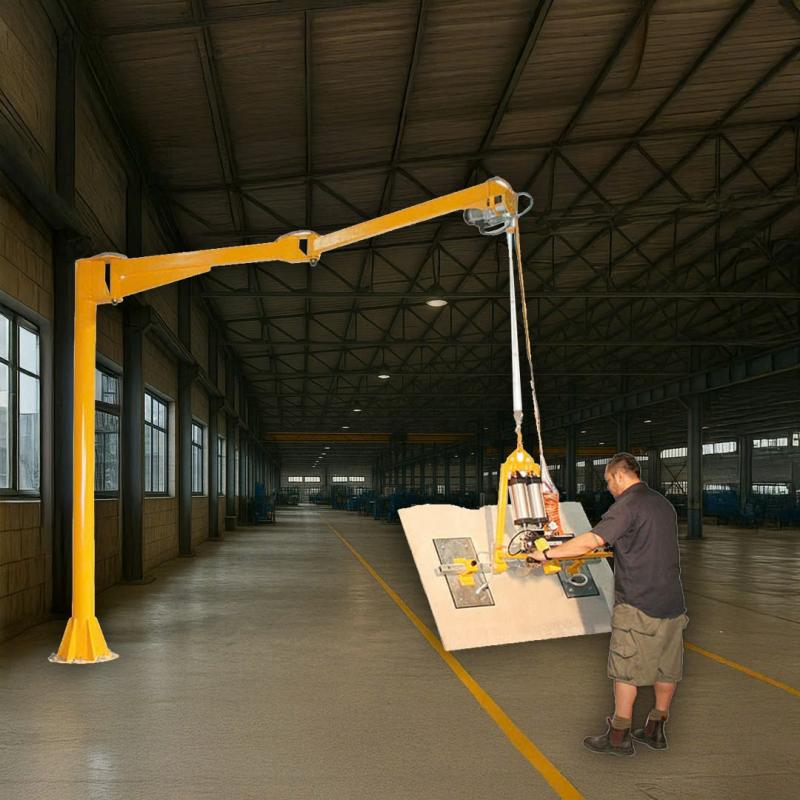
While both jib cranes and overhead cranes play critical roles in streamlining operations, each type offers distinct advantages—and potential limitations—depending on your application.
This article breaks down the key differences, advantages, and best-use scenarios between jib cranes and overhead cranes, helping you decide which system is best suited for your facility.
Explore The efficiency of Jib Cranes for industrial workstations, fabrication shops, warehouses, and more.
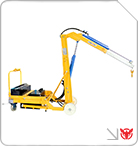
Jib cranes are compact, localized lifting systems with a rotating boom (or “jib”) that supports a lifting hoist. They're commonly used for repetitive lifting in small or medium zones where a full-scale crane system would be overkill.
To explore all available variants, visit the Explore the articulated jib cranes wall-mounted.
Overhead cranes, also known as bridge cranes, are large-scale systems that span the width of a facility. They typically run on fixed runways installed along ceiling beams, covering a wide working area from above. These cranes are commonly used in steel plants, shipyards, warehouses, and heavy manufacturing.
| Feature | Jib Cranes | Overhead Cranes |
|---|---|---|
| Mounting Style | Floor, wall, ceiling, or pillar | Ceiling or runway-mounted |
| Workspace Coverage | Radial (up to 360° rotation) | Rectangular or square facility-wide area |
| Load Capacity | 100 kg – 5 tons (model dependent) | 500 kg – 100+ tons (depending on girder system) |
| Installation Time/Cost | Fast, lower cost, minimal structural mods | Complex install, structural reinforcement needed |
| Flexibility | High for workstations and localized jobs | High for broad, high-capacity lifting |
| Ideal For | Repetitive tasks, assembly lines, CNC loading | Heavy manufacturing, shipping, steelwork |
Need more clarity? Read The difference between a crane vs overhead crane.
Aardwolf’s portfolio includes models tailored for various industries:
Each product is backed by engineering precision and industry-tested durability.
The decision between a jib crane and an overhead crane comes down to your operational footprint, load requirements, and installation possibilities. For ergonomic, station-based lifting, jib cranes offer an unbeatable combination of affordability and precision. For facility-wide lifting of heavy components, overhead cranes are the strategic choice.
Need tailored advice for your facility? Explore How to maximize a Jib Crane or connect with the Aardwolf team for a customized quote and layout assessment.
References
1. How to operate a Jib Cranes safely
3. Over brace jib crane wall mounted
5. Is a Jib Crane a Gantry Crane
6. Articulated Jib Crane Wall Mounted
8. Manual Counterbalance Crane
10. Over Braced Jib Crane Column Mounted
Aardwolf의 신제품, 특별 할인 및 기타 정보를 받으려면 가입하세요.
가입하면 Aardwolf로부터 뉴스, 특별 할인, 프로모션 및 기타 정보를 이메일로 받는 데 동의하게 됩니다. 언제든지 구독을 취소할 수 있습니다.