














 便り
How to Apply Jib Cranes for Productivity and Operational Efficiency
便り
How to Apply Jib Cranes for Productivity and Operational Efficiency
言語を変更する



フォローする


 Share
Share
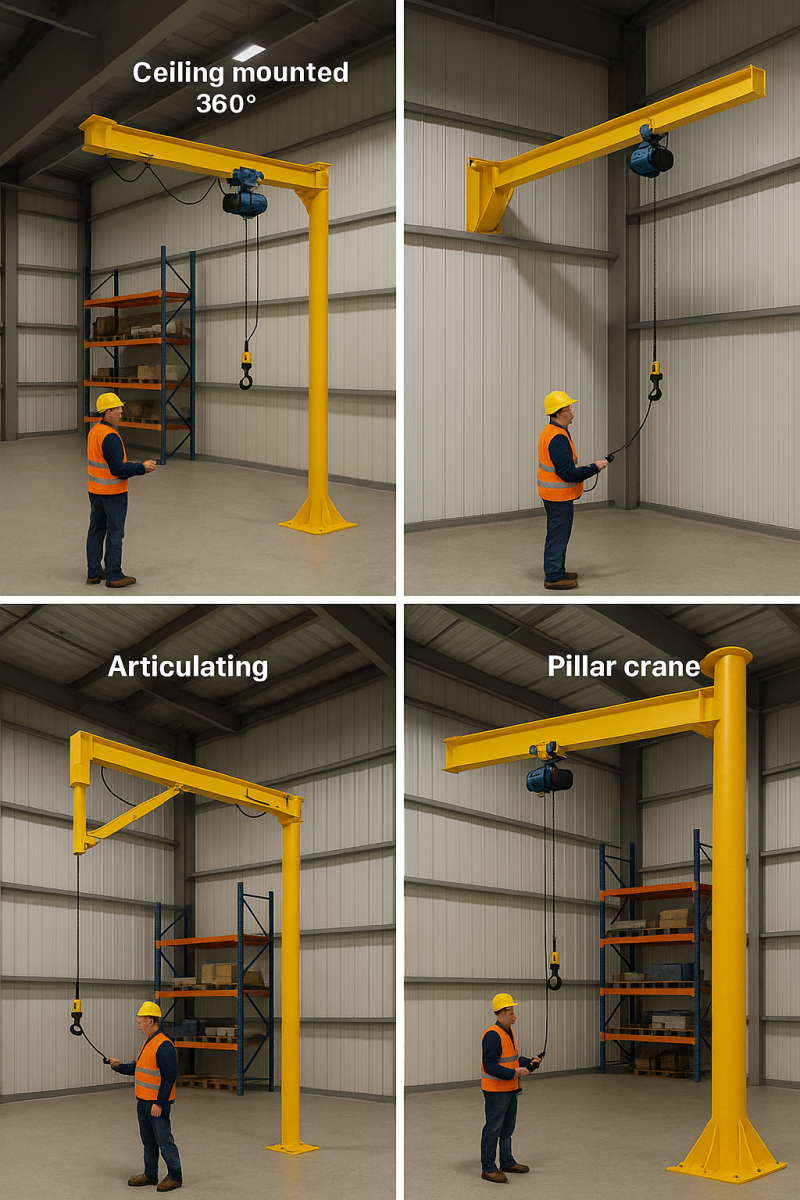
One standout solution is jib cranes—compact, versatile lifting equipment that enhances operational efficiency significantly. Available in various forms such as freestanding jib cranes, wall mounted jib cranes, ceiling mounted jib cranes, articulating jib cranes, and pillar jib cranes, these cranes can precisely cater to specific industrial applications.
This article details practical insights on how businesses can effectively apply jib cranes to maximize productivity, streamline operations, and maintain optimal safety standards.
For an introductory overview, explore What is a crane?.
Before applying jib cranes effectively, it's crucial to understand their foundational types and capabilities clearly:
A freestanding jib crane is a standalone structure, typically bolted to a concrete foundation. It offers a full 360-degree rotation, making it ideal for open environments requiring extensive coverage and heavy lifting capacity.
Ideal for: Warehouses, fabrication shops, loading docks.
A wall mounted jib crane is fixed to a sturdy wall or column, providing rotational coverage of approximately 180–200 degrees. These cranes maximize vertical space efficiency, making them perfect for smaller or congested areas.
Discover detailed insights on this design by clicking Understand a Wall-mounted Jib Crane?.
Ideal for: Compact manufacturing units, assembly lines, and small workshops.
The ceiling mounted jib crane is suspended from overhead structures, significantly freeing up valuable floor space. It ensures unobstructed workspace movement, beneficial for precision assembly tasks.
Ideal for: Cleanrooms, laboratories, electronics manufacturing environments.
The articulating jib crane incorporates multiple pivot points to navigate around obstacles efficiently. It's ideal for tight spaces where precise movement is crucial.
Learn more about detailed specifications in How to design a jib crane.
Ideal for: Automotive assembly lines, machine shops, intricate assembly tasks.
The pillar jib crane is floor-mounted, offering moderate rotation and load capacity. It's particularly beneficial for repetitive tasks in maintenance or workstation areas.
Ideal for: Maintenance workshops, machining stations, small-scale production cells.
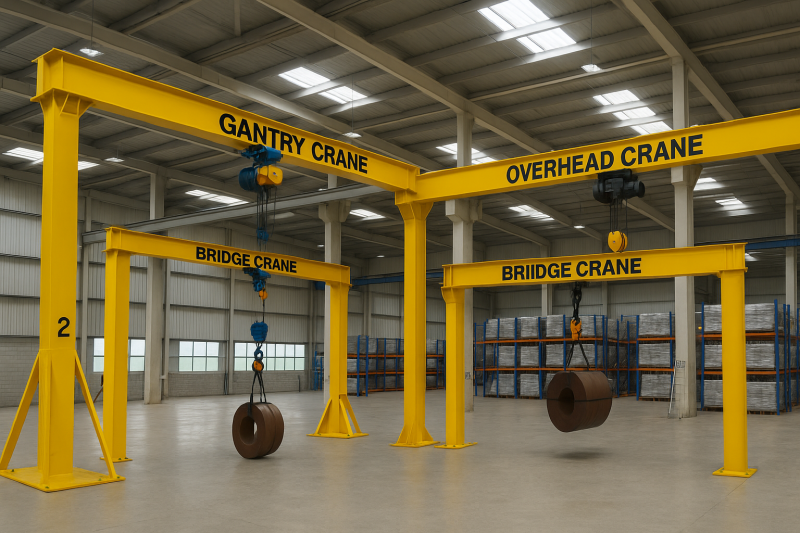
First, assess the workspace and identify your lifting needs:
Space Availability: If space is limited, consider wall-mounted or ceiling-mounted jib cranes. Open spaces suit freestanding jib cranes.
Load Type and Weight: Determine typical load sizes and weights to select a jib crane with appropriate load capacity.
Operational Frequency: High-frequency lifting demands robust cranes with automation capabilities to maintain productivity.
Match your assessed needs to the appropriate jib crane type:
Freestanding cranes for heavy loads and unrestricted space.
Wall-mounted cranes for compact areas with moderate loads.
Ceiling-mounted cranes to optimize overhead space and floor clearance.
Articulating cranes to navigate complex spaces effectively.
Pillar cranes for mid-range capacity tasks near workstations.
For an insightful comparative analysis, explore Jib cranes vs overhead cranes.
Proper planning is key:
Conduct detailed structural assessments for adequate support (walls, floors, ceilings).
Factor in environmental conditions (temperature, humidity, potential corrosive materials).
Integrate appropriate hoist systems, trolleys, and automation features into your crane design.
For comprehensive design guidance, reference How to design a jib crane.
Accurate installation is fundamental for safety and productivity:
Follow precise manufacturer guidelines for crane setup.
Engage certified professionals to handle installation safely.
Regularly inspect all structural connections and anchor points.
For step-by-step instructions, see What is a Jib crane application.
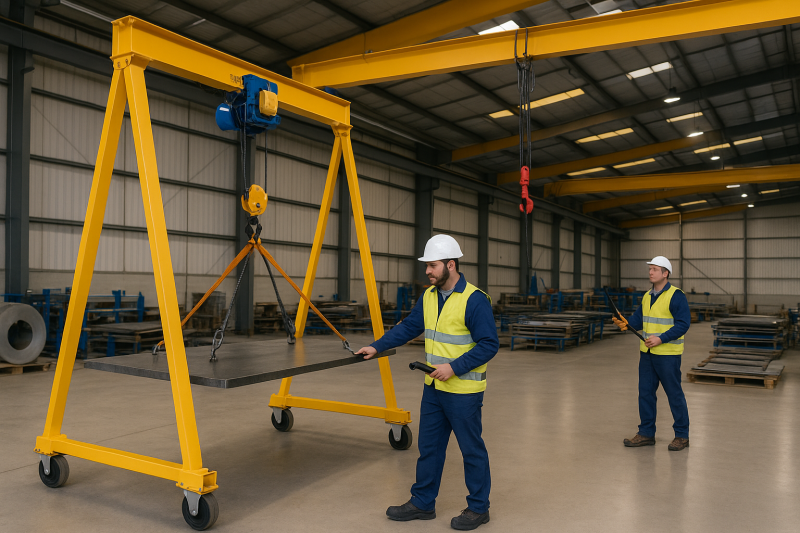
As industries evolve, automated jib cranes become increasingly prevalent. Automated features significantly enhance productivity and safety, enabling:
Precise and repetitive task execution.
Remote control operations reducing manual risk.
Sensors and monitoring systems for proactive maintenance.
To prepare for these emerging innovations, learn more at Industrial Jib Cranes Future.
Maximize efficiency and safety with proper operational practices:
Operator Training: Train your operators thoroughly in crane functionalities, load limitations, and emergency procedures.
Regular Maintenance: Implement a consistent maintenance schedule to ensure your crane's longevity and reliability.
Operational Checks: Regularly conduct pre-operation inspections to verify load-bearing capabilities, structural integrity, and operational readiness.
Explore operational specifics at How to design a jib crane.
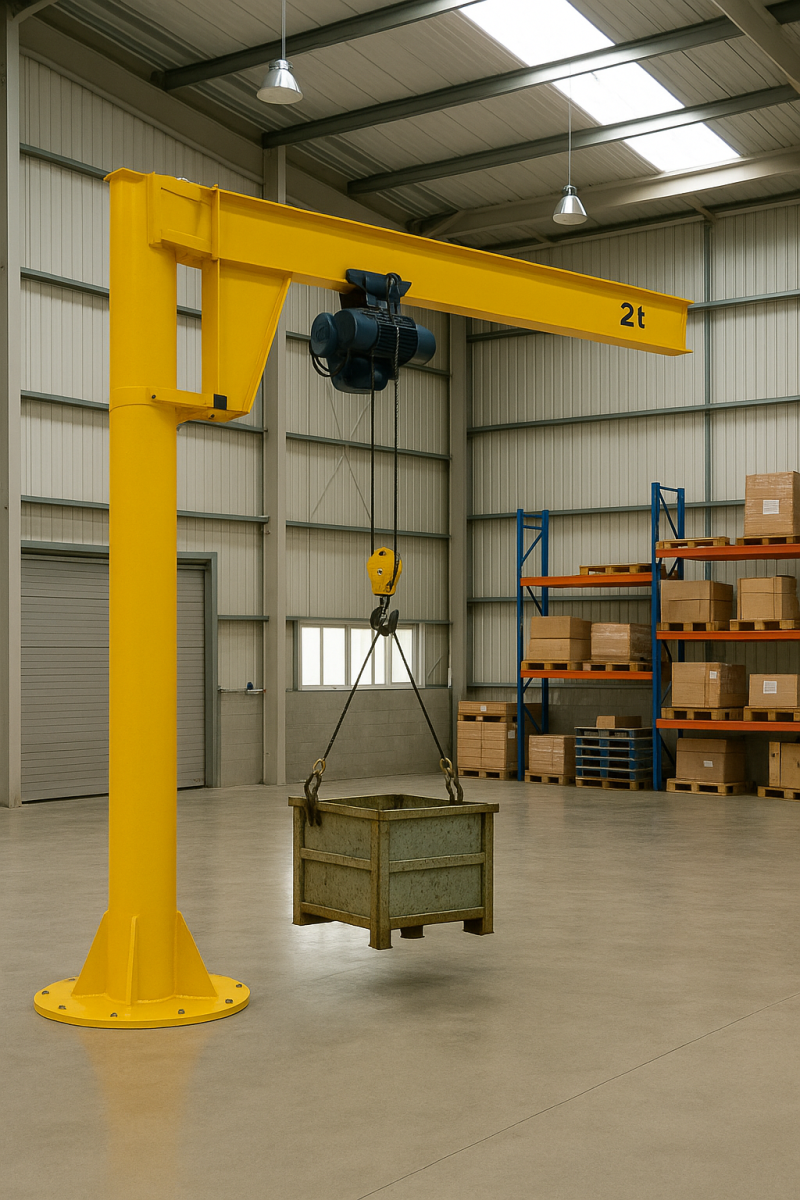
Manufacturing Lines: Wall-mounted jib cranes optimize small workspaces for efficient material handling.
Automotive Workshops: Articulating jib cranes provide essential flexibility around machinery and assembly lines.
Loading Docks: Freestanding jib cranes streamline cargo handling, minimizing loading/unloading delays.
Maintenance Facilities: Pillar jib cranes facilitate efficient and precise part positioning, improving repair times.
These examples underscore the jib cranes' crucial role in modern industrial operations.
Proper application and strategic planning of jib cranes significantly enhance operational efficiency, safety, and productivity across industries. By carefully selecting the appropriate jib crane—freestanding, wall-mounted, ceiling-mounted, articulating, or pillar-mounted—and effectively integrating automated features, businesses can gain a substantial competitive edge.
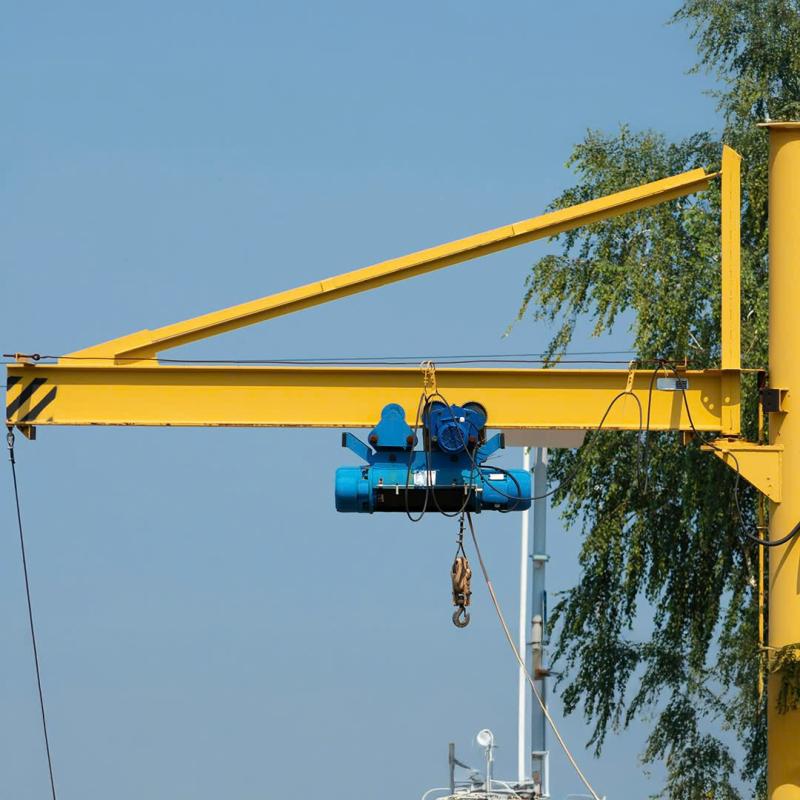
To further understand crane capabilities and refine your selection process, start your journey with What is a crane?. By staying ahead of industry innovations, companies can ensure they remain at the forefront of operational excellence.
References
1. How to operate a Jib Cranes safely
3. Over brace jib crane wall mounted
5. Is a Jib Crane a Gantry Crane
6. Articulated Jib Crane Wall Mounted
8. Manual Counterbalance Crane
10. Over Braced Jib Crane Column Mounted
Aardwolfの新製品、特別オファーなどの最新情報を受け取るにはご登録ください。
登録すると、Aardwolfからニュース、特別オファー、プロモーション、その他の情報を含むメールを受け取ることに同意したことになります。いつでも配信停止できます。